My work focuses on identifying etiological biomarkers of chronic diseases, neurological disorders, and psychological wellbeing. I am passionate about combining machine learning and artificial intelligence techniques to develop predictive, preventative, and precision medicine for treating or alleviating chronic diseases.
Many chronic diseases such as Alzheimer's disease, cancer, and mental health disorders are easier to treat when detected early. Through my research, I advance the creation of biomarker screening, vaccines, and tailored treatments. I believe that these tools can revolutionize medicine and medical care by increasing our understanding of disease and making personalized medicine more accessible.
I have presented my research at a number of notable conferences including the American Public Health Association Annual Meeting & Expo, the IEEE Engineering in Medicine and Biology Conference, and the Stanford School of Medicine’s Maternal & Child Health Research Institute Symposium.
Uncovering complexities of societal challenges, identifying impacts of these challenges, and evaluating evidence-based solutions.
Developing effective methods to discover, enhance, or develop predictive, preventive, and precision medicine for treating or alleviating chronic diseases.
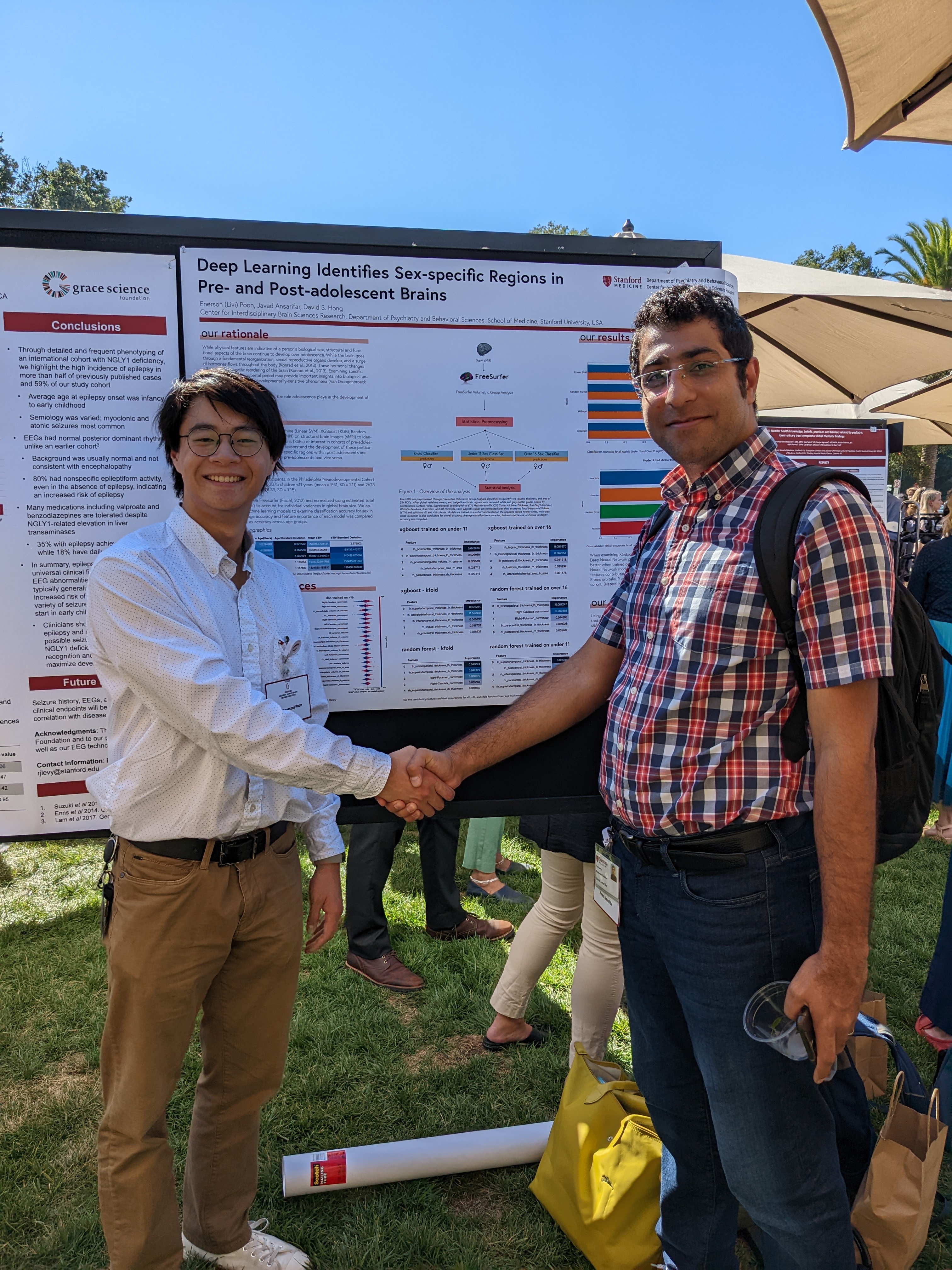
Developing machine learning models to identify and compare sex-specific brain regions in preadolescents and adolescents.
From an early age, I have been interested in computer programming, science, and entrepreneurship. I began programming in Scratch with a heavy interest in game design. Feeling limited by the rigidity of Scratch, I met Dr. Jen Selby who introduced me to Python. Working with Dr. Selby, I learned to develop my own video games, catapult simulators, and soon embedded systems projects.
From that point forward I branched out into a variety of embedded systems projects and software development projects. I took on leadership roles including being the Chief Operations Officer of the newly formed SchoolHacks and the team lead of a group tasked with developing a thermodynamics experiment to be sent to the International Space Station. I also was a technical support intern at the Innovative Learning Conference for 4 consecutive years.
As I transitioned into highschool, my projects shifted more towards research. Landing an internship at the Center for Interdisciplinary Brain Sciences Research at the Stanford School of Medicine was a turning point in my career. There I learned how to develop machine learning models, manually correct MRI images, and even got certified and operated 3T3 & 3T2 MRI machines at the Richard m. Lucas Center for Imaging.
As a result of my success, I was invited to continue my research throughout my sophomore year of highschool. Within a new project, I used machine learning models to identify and compare brain regions in preadolescents and adolescents that determine biological sex.
Continuing my research throughout highschool, I had the wonderful opportunity of applying for and presenting at the 2022 Stanford School of Medicine’s Maternal & Child Health Research Institute Symposium as a first author.
Before committing to the University of Vermont, I received 4 research lab offers. I choose to work with Dr. Nick Cheney and his lab, the Neurobotics Lab due the lab's focus on taking biological approaches to machine learning and implementing machine learning in real-world medical applications. There I worked on a project to develop a selection algorithm to identify pre-pregnancy features associated with preeclampsia onset and birth weight percentile. This work was presented at the IEEE Engineering in Medicine and Biology Conference in Orlando, Florida.
Feeling like I had exhausted all of the different research avenues on the dataset I was utilizing. After meeting with Dr. Chris Danforth, I transitioned from preeclampsia research to mental health and wellbeing research. Within the Lived Experiences Measured Using Rings Study (LEMURS), I studied how body composition and psychosocial factors like self-compassion and social support change across seasons in college students and identified key patterns that could help improve mental health interventions and support.
My work was recognized as a key contribution to the University of Vermont's scientific community through the awarding of a Summer Undergraduate Research Fellowship.
During my sophomore year, I started to feel uneasy about my growth as a researcher. Although I was diving deep into statistical analysis, I realized my machine learning skills were not advancing the way I had hoped. I wanted a real challenge—something that would test not just my technical abilities, but also my understanding of machine learning concepts from the ground up. So, I decided to tackle a passion project, choosing a widely studied topic to see how far I could push myself.
I chose to tackle the challenge of predicting chronic disease death rates across U.S. states using machine learning. This project allowed me to explore the complexities of data analysis, model selection, and predictive accuracy. Through this experience, I gained a deeper understanding of the challenges and opportunities in applying machine learning to real-world problems. It was recognized through the submission and acceptance at the 2025 American Public Health Association Annual Meeting & Expo in Washington, D.C.